
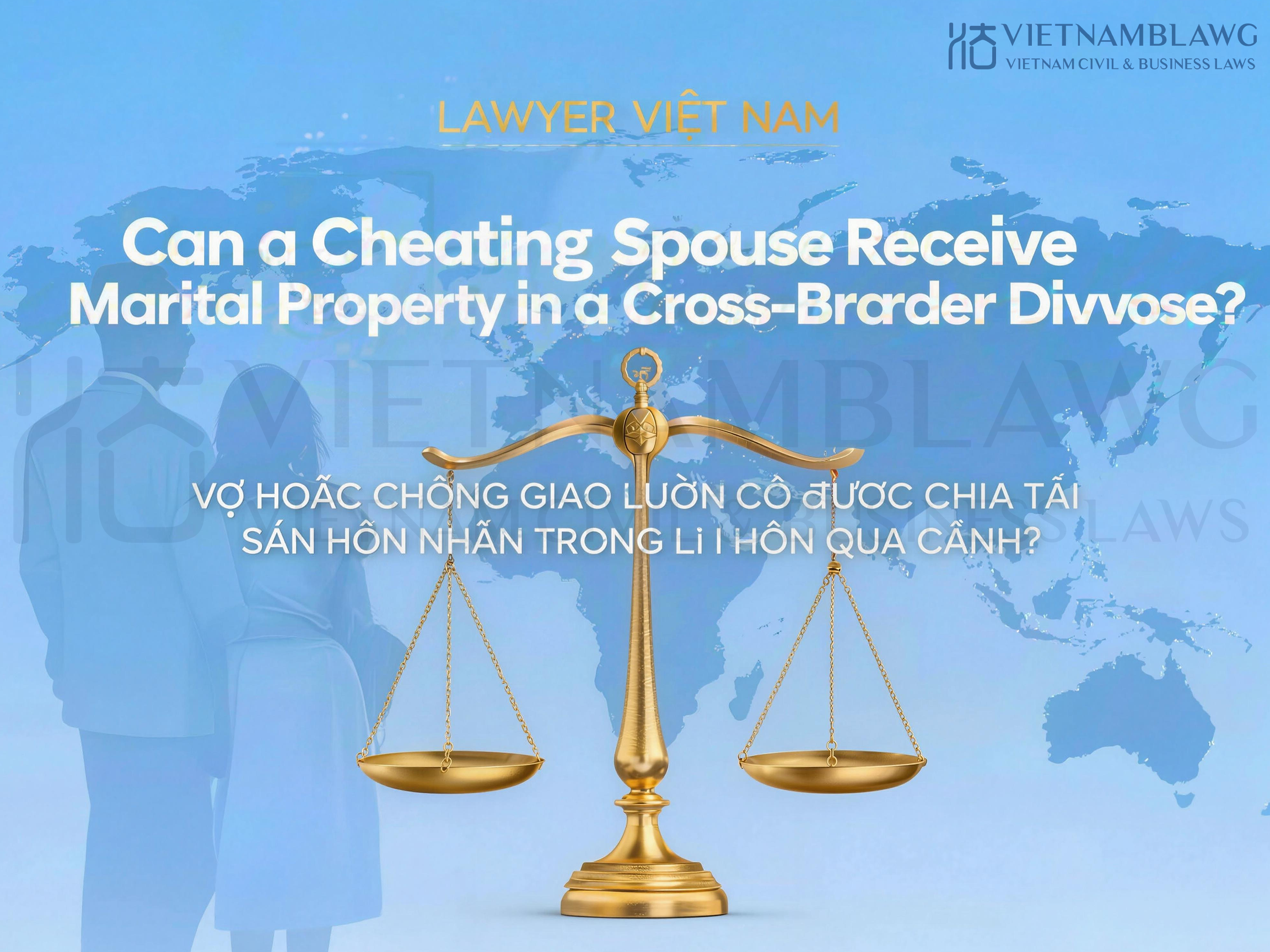

Divorce rarely occurs without underlying reasons, and one of the most sensitive issues frequently raised by our readers concerns infidelity. We often receive questions such as:
"If my spouse cheated on me, can they still receive marital property after divorce?"
"If my spouse had an affair, will they lose their rights to our assets?"
"Can a cheating spouse face legal penalties under Vietnamese law?"
These questions become even more complex when the marriage involves foreign elements, such as a foreign spouse, overseas assets, or a marriage registered abroad.
This article explains how Vietnamese law addresses these issues and how these rules apply in divorce cases involving foreign elements.
Can a Cheating Spouse Receive Marital Property After Divorce?
The short answer is: Yes, a cheating spouse may still receive a share of marital property after divorce.
Under Article 59 of the Law on Marriage and Family 2014, marital property is first divided according to the agreement of the spouses. If the parties cannot reach an agreement, the court will determine the division of assets.
According to Clause 2, Article 59 of the Law on Marriage and Family 2014, although common marital property is generally divided equally, the court may consider several factors, including:
- The circumstances of the family and each spouse;
- The contribution of each spouse to the creation, maintenance, and development of marital assets;
- The protection of each spouse's legitimate interests in business activities and professional work;
- The fault of either spouse in violating marital rights and obligations.
This means that under Vietnamese law, adultery itself does not automatically deprive a spouse of the right to receive marital property. However, the misconduct of a spouse may be considered as one factor among others when determining a fair division of assets.
For example, if the court determines that a spouse's affair significantly contributed to the breakdown of the marriage, that factor may affect the proportion of marital assets allocated to each party.
How Does This Apply to Divorce Cases Involving Foreign Elements?
For marriages involving foreign elements, the issue becomes more complex because the analysis is no longer limited to whether one spouse committed adultery.
Under Article 127 of the Law on Marriage and Family 2014, divorce involving foreign elements may arise where:
- One spouse is a foreign national;
- One or both spouses reside abroad;
- The marriage was registered overseas; or
- Marital property is located outside Vietnam.
In these situations, additional legal questions arise, including:
- Which country's law applies?
- Which court has jurisdiction?
- Which country's laws govern the property?
For example: A Vietnamese citizen and a foreign spouse may own:
- an apartment in Vietnam;
- a bank account in Singapore;
- a house in Australia.
In such circumstances, different assets may be governed by different legal rules. Assets located in Vietnam may be resolved under Vietnamese law, while overseas immovable property is generally subject to the laws of the country where the property is located.
However, even in divorce cases involving foreign elements, the general principle under Article 59 of the Law on Marriage and Family 2014 remains relevant: A cheating spouse does not automatically lose the right to receive marital property.
The court may still consider the fault of a spouse in violating marital obligations when determining a fair division of assets, but adultery itself does not automatically remove property rights.
Can a Cheating Spouse Face Legal Penalties Under Vietnamese Law?
If a cheating spouse may still receive marital assets after divorce, many people naturally wonder whether such conduct may result in legal consequences.
The answer is: Yes, in certain circumstances.
Pursuant to Clause 1, Article 59 of Decree No. 82/2020/NĐ-CP, individuals may be subject to administrative fines ranging from VND 3,000,000 to VND 5,000,000 for violations relating to marriage and the one-spouse regime.
These include:
- A married person marrying another person;
- A married person living together with another person as husband and wife;
- An unmarried person knowingly living with someone who is already married.
Therefore, not every act commonly described as "cheating" automatically results in legal penalties. Vietnamese law generally requires evidence of conduct such as marriage to another person or cohabitation in a husband-and-wife relationship.
Conclusion
Under Vietnamese law, a cheating spouse generally does not automatically lose the right to receive marital property after divorce, including in divorce cases involving foreign elements. Under Article 59 of the Law on Marriage and Family 2014, marital misconduct may be considered by the court when dividing property, but it is only one of several factors taken into account.
For international couples, issues relating to jurisdiction, applicable law, and the location of assets often become equally important as the issue of adultery itself. As a result, cross-border divorce disputes frequently require a broader legal analysis beyond the question of who was at fault in the marriage.

Comments