
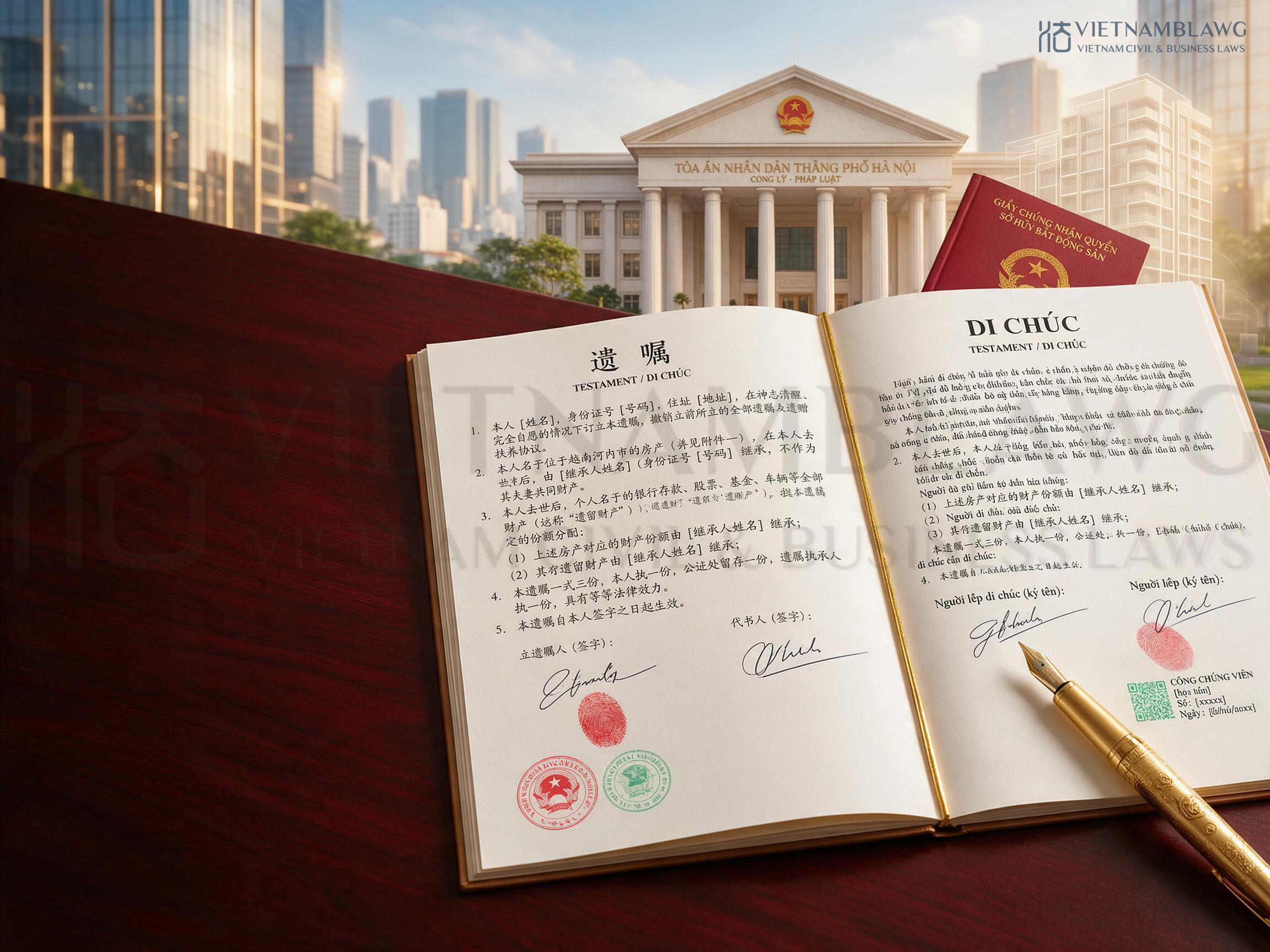

Recently, the Supreme People’s Court in Ho Chi Minh City, Vietnam, issued a verdict that declared invalid a will executed in the state of Texas in the United States by a late Vietnamese artist. This verdict has raised major concerns among foreigners and overseas Vietnamese who own properties in Vietnam and may have made a will or will make estate planning for their properties in Vietnam. So, how to make a will for your assets in Vietnam and have it enforced in Vietnam? Let’s find out more under Vietnamese laws.
1. Conditions for a will executed abroad to be valid in Vietnam:
As a matter of cross-border legal issues within Vietnam, the first thing needs to be decided is what applicable law shall be applied to address the said legal issues. Vietnam doesn't have an independant statute like China on choice of applicable laws, but in Vietnam Civil Code, there are explicit rules determining the choice of applicable law in this regard.
Clause 2 of Article 681 of the Civil Code 2015 of Vietnam provides for the applicable laws for a given will. The form of the will shall be determined according to the law of the country where the will is executed. The form of the will is also recognized in Vietnam if it complies with the law of one of the following countries:
- The country where the testator resided at the time the will was executed or at the time of the testator’s death;
- The country of which the testator was a national at the time the will was executed or at the time of the testator’s death;
- The country where the real property is located, if the estates disposed in the will consists of real property.
Furthermore, for Vietnamese citizens residing abroad, pursuant to Clause 5 of Article 638 of the Civil Code 2015 of Vietnam, if the will is executed in writing, it shall be certified by the Vietnamese consular authority or diplomatic mission in that country.
2. Other conditions related to the contents of the will:
In addition, the fact that a will has been executed in a form that meets the legal requirements does not automatically mean it will be recognized and enforced in Vietnam. For a will to be valid, in addition to the formal requirements, the mental conditions of the testator at the time of executing the will and the contents of the will must also satisfy sustantive requirements of Vietnamese laws (for purpose of limiting the length of this article, we will drill on applicable laws in respect of substantive aspects of a will).
Accordingly, pursuant to Articles 674 and 681 of the Civil Code of Vietnam: The civil act capacity of an individual shall be determined in accordance with the law of the country of which such person is a national. The capacity to make a will shall be determined according to the law of the country of which the testator was a national at the time of executing, modifying or revoking the will, however in cases where a foreigner makes a will in Vietnam, the civil act capacity of such foreigner shall be determined in accordance with Vietnamese law. The civil act capacity is determined in accordance with Vietnamese law must follow the article 625 and 630 of the Civil Code of Vietnam, as below:
- The testator must be of sound mind when executing the will; and must not have been deceived, threatened or coerced;
- Awill executed by a testator aged from fifteen to under eighteen years must be executed in writing and must be consented to by the parents or guardian regarding the execution of the will;
- A will of a person with physical disabilities or of an illiterate person must be made in writing by a witness and must be notarized or authenticated;
- The content of the will must not violate any prohibition of the law or be contrary to social ethics;and the form of the will must not be contrary to the provisions of the law.
Furthermore, Vietnamese law allows the testator to execute an oral will in cases where a person’s life is under threat of death, and it is impossible to make a written will. The testator executing an oral will must express their final wishes in the presence of at least two witnesses, and immediately after the oral will is expressed, the witnesses must record it in writing and jointly sign or affix their fingerprints. Within five working days from the date the oral will is expressed, the will must be confirmed by a notary public or a competent authority regarding the signatures or fingerprints of the witnesses. After three months from the time the oral will is executed, if the testator is still alive, of sound and clear mind, the oral will is automatically revoked.
3. Notes on the enforcement of wills in Vietnam:
Pursuant to Article 643 of the Civil Code of Vietnam, a will takes effect from the time the inheritance is opened (The time of the testator’s death) and shall be wholly or partially invalid in the following circumstances:
- The beneficiary dies before or at the same time as the testator;
- The agency or organization designated as a beneficiary no longer exists at the time the inheritance is opened.
- In cases where there are multiple beneficiaries and one of them dies before or at the same time as the testator, or where one of the multiple agencies or organizations designated to be a beneficiary no longer exists at the time the inheritance is opened, only the portion of the will relating to such individual, agency, or organization shall be invalid.
- The will shall be invalid if the inheritance no longer exists at the time the inheritance is opened; if only a portion of the inheritance remains, the portion of the will relating to the remaining inheritance shall still be valid.
- Where a part of the will is unlawful but does not affect the validity of the remaining parts, only that part shall be invalid.
- Where a person leaves multiple wills in respect of the same property, only the last will shall be valid.
In addition, it should be noted that Vietnamese law does not solely rely on the will for the distribution of inheritance. Pursuant to Article 644 of the Civil Code, the following persons are still entitled to a portion of the inheritance equal to two-thirds of the share of an heir at law if the inheritance were distributed according to the law, in cases where they are not bequeathed any inheritance by the testator or are bequeathed less than two-thirds of such share:
- Minor children, the father, mother, spouse;
- Adult children who are incapable of working.
This is the forced heirship of Vietnamese inheritance law. It is essential for foreigners or overseas Vietnamese who prepare their estate planning over real properties in Vietnam, because in respect of real properties in Vietnam, the Vietnamese inheritance law will govern the inheritance and distribution of such real properties in Vietnam. Indeed, as reflected in the news about the Vietnamese singer mentioned at the beginning of the article, he left everything to his wife failing to leave proper portions for his mother and minor children.
People outside of Vietnam may often not be aware of such forced heirship rules and inadvertantly fall into such traps when they do their estate planning without seeking advice from Vietnamese estate lawyers.
4. Notes for the heirs:
An heir has the right to refuse the inheritance and may also be disqualified from inheriting in the circumstances provided under Article 621 of the Civil Code, as follows:
- An heir who has been convicted of intentionally infringing upon the life or health of the person leaving the inheritance, or of seriously mistreating or torturing such person, or of seriously infringing upon the honor or dignity of such person;
- An heir who has seriously violated the obligation to support the person leaving the inheritance;
- A person who has been convicted of intentionally infringing upon the life of another heir to obtain a part or the whole of the share of the inheritance that such heir is entitled to;
- A person who has committed acts of deception, coercion, or obstruction against the person leaving the inheritance in the execution of a will; or who has forged, altered, destroyed, or concealed a will to obtain a part or the whole of the inheritance contrary to the will of the person leaving the inheritance.
If the person leaving the inheritance was aware of such acts but still bequeathed the inheritance to them under the will, they shall still be entitled to inherit under the will.
The statute of limitations for requesting the distribution of inheritance is 30 years for real property and 10 years for movable property, counting from the time the inheritance is opened. Upon the expiry of this period, the inheritance shall belong to the heir who is managing such inheritance.
5. Mandatory contents of a will:
Pursuant to Article 631 of the Civil Code, a will must contain the following contents:
- The date, month and year on which the will is executed;
- The full name and place of residence of the testator;
- The full name of the individual, agency or organization entitled to the inheritance;
- The estates to be bequeathed and the location of the estates.
- In addition to the above contents, a will may contain other contents.
Notes:
- A will must not be written in abbreviations or symbols. If the will consists of multiple pages, each page must be numbered and bear the signature or fingerprint of the testator.
- In case the will contains any erasures or corrections, the person who wrote the will themselves or the witness to the will must sign next to the erased or corrected parts.
- Any person may act as a witness to the making of a will, except for the following persons:
- Heirs under the will or under the law of the testator;
- Persons who have rights or property obligations related to the content of the will;
- Minors, persons who have lost civil act capacity, or persons with difficulties in cognition or behavioral control.
Vietnamese law has very strict regulations regarding wills. Therefore, if you are facing legal issues or wish to execute a will to be enforced in Vietnam but are uncertain about the contents, please contact us for further advice.
Comments